39 - Yttrium transition metal
Discovered by Johan Gadolin in 1794
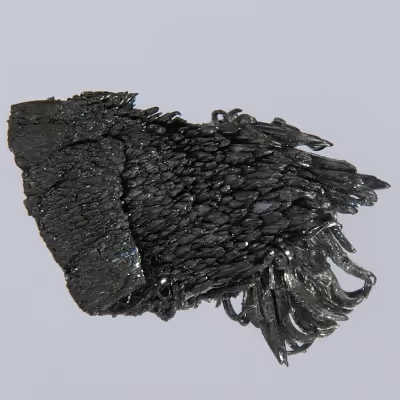
Yttrium is a chemical element with symbol Y and atomic number 39. It is a silvery-metallic transition metal chemically similar to the lanthanides and it has often been classified as a "rare earth element". Yttrium is almost always found combined with the lanthanides in rare earth minerals and is never found in nature as a free element.
Periodic table
| Shell | Electrons | Orbitals |
|---|---|---|
| 1 | 2 | 2 in 1s |
| 2 | 8 | 2 in 2s + 6 in 2p |
| 3 | 18 | 2 in 3s + 6 in 3p + 10 in 3d |
| 4 | 9 | 2 in 4s + 6 in 4p + 1 in 4d |
| 5 | 2 | 2 in 5s |
Electron shells
silvery white Appearance
88.9 u Atomic Mass
1.8 Å Atomic Radius
3.61k K Boiling Point
3 Group
3 Common Oxidation States
1.9 Å Covalent Radius
4.47 g/cm³ Density
29.6 kJ/mol Electron Affinity
1s2 2s2 2p6 3s2 3p6 4s2 3d10 4p6 5s2 4d1 Electron Configuration
[Kr] 4d1 5s2 Electron Configuration (semantic)
1.22 Electronegativity
39 Electrons
6.22 eV First Ionization Energy
3 ICSD Oxidation States
600, 1180, 1980, 5847, 7430, 8970, 11190, 12450, 14110, 18400, 19900, 36090 kJ/mol Ionization Energies
1.8k K Melting Point
25 Mendeleev Number
26.5 J/(mol·K) Molar Heat
5 Number of Shells
50 Neutrons
39 Atomic Number
21 Number of Isotopes
1, 2, 3 Oxidation States
5 Period
Solid Phase
39 Protons
2, 8, 18, 9, 2 Electron Shell Occupations