5 - Boron metalloid
Discovered by Joseph Gay-Lussac in 1808
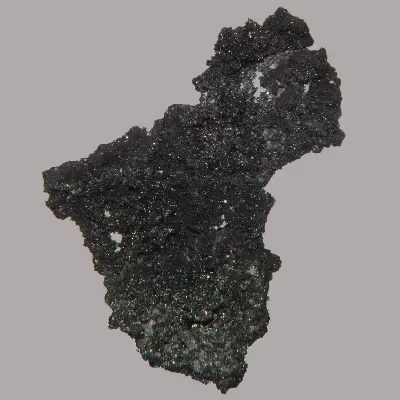
Boron is a metalloid chemical element with symbol B and atomic number 5. Produced entirely by cosmic ray spallation and supernovae and not by stellar nucleosynthesis, it is a low-abundance element in both the Solar system and the Earth's crust. Boron is concentrated on Earth by the water-solubility of its more common naturally occurring compounds, the borate minerals.
Periodic table
| Shell | Electrons | Orbitals |
|---|---|---|
| 1 | 2 | 2 in 1s |
| 2 | 3 | 2 in 2s + 1 in 2p |
Electron shells
black-brown Appearance
10.8 u Atomic Mass
0.85 Å Atomic Radius
4.2k K Boiling Point
13 Group
3 Common Oxidation States
0.84 Å Covalent Radius
2.08 g/cm³ Density
27 kJ/mol Electron Affinity
1s2 2s2 2p1 Electron Configuration
[He] 2s2 2p1 Electron Configuration (semantic)
2.04 Electronegativity
5 Electrons
8.3 eV First Ionization Energy
-3, 3 ICSD Oxidation States
800.6, 2427.1, 3659.7, 25025.8, 32826.7 kJ/mol Ionization Energies
2.57k K Melting Point
86 Mendeleev Number
11.1 J/(mol·K) Molar Heat
2 Number of Shells
3 Electron Valency
6 Neutrons
5 Atomic Number
6 Number of Isotopes
1, 2, 3 Oxidation States
2 Period
Solid Phase
5 Protons
2, 3 Electron Shell Occupations
1.03 J/(g K) Specific Heat