36 - Krypton noble gas
Discovered by William Ramsay in 1898
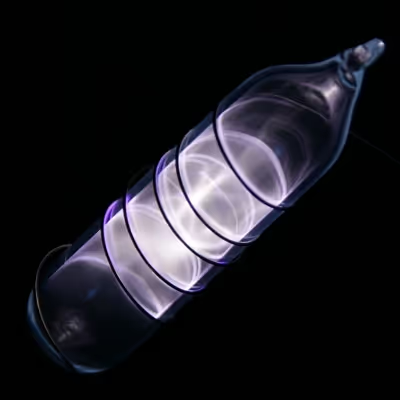
Krypton (from Greek:κρυπτός kryptos "the hidden one") is a chemical element with symbol Kr and atomic number 36. It is a member of group 18 (noble gases) elements. A colorless, odorless, tasteless noble gas, krypton occurs in trace amounts in the atmosphere, is isolated by fractionally distilling liquefied air, and is often used with other rare gases in fluorescent lamps.
Periodic table
| Shell | Electrons | Orbitals |
|---|---|---|
| 1 | 2 | 2 in 1s |
| 2 | 8 | 2 in 2s + 6 in 2p |
| 3 | 18 | 2 in 3s + 6 in 3p + 10 in 3d |
| 4 | 8 | 2 in 4s + 6 in 4p |
Electron shells
colorless gas, exhibiting a whitish glow in a high electric field Appearance
83.8 u Atomic Mass
120 K Boiling Point
18 Group
2 Common Oxidation States
1.16 Å Covalent Radius
0.00375 g/cm³ Density
−96 kJ/mol Electron Affinity
1s2 2s2 2p6 3s2 3p6 4s2 3d10 4p6 Electron Configuration
[Ar] 3d10 4s2 4p6 Electron Configuration (semantic)
36 Electrons
14 eV First Ionization Energy
1350.8, 2350.4, 3565, 5070, 6240, 7570, 10710, 12138, 22274, 25880, 29700, 33800, 37700, 43100, 47500, 52200, 57100, 61800, 75800, 80400, 85300, 90400, 96300, 101400, 111100, 116290, 282500, 296200, 311400, 326200 kJ/mol Ionization Energies
116 K Melting Point
4 Mendeleev Number
4 Number of Shells
8 Electron Valency
48 Neutrons
36 Atomic Number
23 Number of Isotopes
4 Period
Gas Phase
36 Protons
2, 8, 18, 8 Electron Shell Occupations