50 - Tin post-transition metal
Discovered by before 3500 BC in ~3500 BC
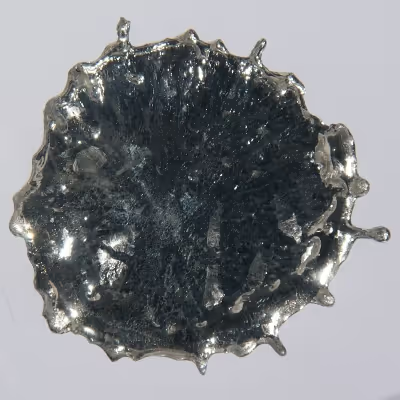
Tin is a chemical element with the symbol Sn (for Latin:stannum) and atomic number 50. It is a main group metal in group 14 of the periodic table. Tin shows a chemical similarity to both neighboring group-14 elements, germanium and lead, and has two possible oxidation states, +2 and the slightly more stable +4.
Periodic table
| Shell | Electrons | Orbitals |
|---|---|---|
| 1 | 2 | 2 in 1s |
| 2 | 8 | 2 in 2s + 6 in 2p |
| 3 | 18 | 2 in 3s + 6 in 3p + 10 in 3d |
| 4 | 18 | 2 in 4s + 6 in 4p + 10 in 4d |
| 5 | 4 | 2 in 5s + 2 in 5p |
Electron shells
silvery-white (beta, β) or gray (alpha, α) Appearance
119 u Atomic Mass
1.45 Å Atomic Radius
2.88k K Boiling Point
14 Group
-4, 2, 4 Common Oxidation States
1.39 Å Covalent Radius
7.37 g/cm³ Density
107 kJ/mol Electron Affinity
1s2 2s2 2p6 3s2 3p6 4s2 3d10 4p6 5s2 4d10 5p2 Electron Configuration
[Kr] 4d10 5s2 5p2 Electron Configuration (semantic)
1.96 Electronegativity
50 Electrons
7.34 eV First Ionization Energy
2, 3, 4 ICSD Oxidation States
708.6, 1411.8, 2943, 3930.3, 7456 kJ/mol Ionization Energies
505 K Melting Point
83 Mendeleev Number
27.1 J/(mol·K) Molar Heat
5 Number of Shells
4 Electron Valency
69 Neutrons
50 Atomic Number
28 Number of Isotopes
-4, 2, 4 Oxidation States
5 Period
Solid Phase
50 Protons
2, 8, 18, 18, 4 Electron Shell Occupations
0.228 J/(g K) Specific Heat