98 - Californium actinide
Discovered by Lawrence Berkeley Laboratory in 1950
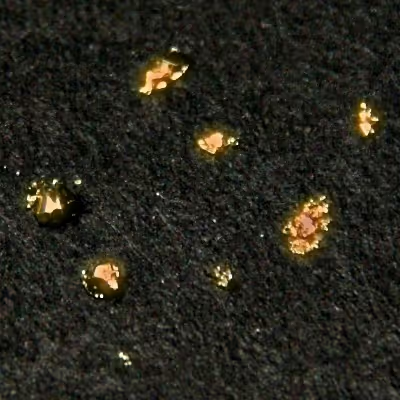
Californium is a radioactive metallic chemical element with symbol Cf and atomic number 98. The element was first made in 1950 at the University of California Radiation Laboratory in Berkeley, by bombarding curium with alpha particles (helium-4 ions). It is an actinide element, the sixth transuranium element to be synthesized, and has the second-highest atomic mass of all the elements that have been produced in amounts large enough to see with the unaided eye (after einsteinium).
Periodic table
| Shell | Electrons | Orbitals |
|---|---|---|
| 1 | 2 | 2 in 1s |
| 2 | 8 | 2 in 2s + 6 in 2p |
| 3 | 18 | 2 in 3s + 6 in 3p + 10 in 3d |
| 4 | 32 | 2 in 4s + 6 in 4p + 10 in 4d + 14 in 4f |
| 5 | 28 | 2 in 5s + 6 in 5p + 10 in 5d + 10 in 5f |
| 6 | 8 | 2 in 6s + 6 in 6p |
| 7 | 2 | 2 in 7s |
Electron shells
silvery Appearance
251 u Atomic Mass
1.17k K Boiling Point
12 Group
3 Common Oxidation States
15.1 g/cm³ Density
−97.3 kJ/mol Electron Affinity
1s2 2s2 2p6 3s2 3p6 4s2 3d10 4p6 5s2 4d10 5p6 6s2 4f14 5d10 6p6 7s2 5f10 Electron Configuration
[Rn] 5f10 7s2 Electron Configuration (semantic)
1.3 Electronegativity
98 Electrons
6.28 eV First Ionization Energy
608 kJ/mol Ionization Energies
1.93k K Melting Point
39 Mendeleev Number
7 Number of Shells
153 Neutrons
98 Atomic Number
123 Number of Isotopes
2, 3, 4 Oxidation States
7 Period
Solid Phase
98 Protons
2, 8, 18, 32, 28, 8, 2 Electron Shell Occupations