77 - Iridium transition metal
Discovered by Smithson Tennant in 1804
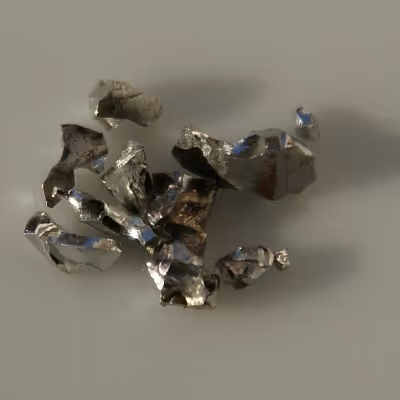
Iridium is a chemical element with symbol Ir and atomic number 77. A very hard, brittle, silvery-white transition metal of the platinum group, iridium is generally credited with being the second densest element (after osmium) based on measured density, although calculations involving the space lattices of the elements show that iridium is denser. It is also the most corrosion-resistant metal, even at temperatures as high as 2000 °C. Although only certain molten salts and halogens are corrosive to solid iridium, finely divided iridium dust is much more reactive and can be flammable.
Periodic table
| Shell | Electrons | Orbitals |
|---|---|---|
| 1 | 2 | 2 in 1s |
| 2 | 8 | 2 in 2s + 6 in 2p |
| 3 | 18 | 2 in 3s + 6 in 3p + 10 in 3d |
| 4 | 32 | 2 in 4s + 6 in 4p + 10 in 4d + 14 in 4f |
| 5 | 15 | 2 in 5s + 6 in 5p + 7 in 5d |
| 6 | 2 | 2 in 6s |
Electron shells
silvery white Appearance
192 u Atomic Mass
1.35 Å Atomic Radius
4.7k K Boiling Point
9 Group
3, 4 Common Oxidation States
1.41 Å Covalent Radius
22.6 g/cm³ Density
151 kJ/mol Electron Affinity
1s2 2s2 2p6 3s2 3p6 4s2 3d10 4p6 5s2 4d10 5p6 6s2 4f14 5d7 Electron Configuration
[Xe] 4f14 5d7 6s2 Electron Configuration (semantic)
2.2 Electronegativity
77 Electrons
8.97 eV First Ionization Energy
3, 4, 5 ICSD Oxidation States
880, 1600 kJ/mol Ionization Energies
2.72k K Melting Point
66 Mendeleev Number
25.1 J/(mol·K) Molar Heat
6 Number of Shells
115 Neutrons
77 Atomic Number
25 Number of Isotopes
-3, -1, 1, 2, 3, 4, 5, 6 Oxidation States
6 Period
Solid Phase
77 Protons
2, 8, 18, 32, 15, 2 Electron Shell Occupations