47 - Silver transition metal
Discovered by before 5000 BC in ~3000 BC
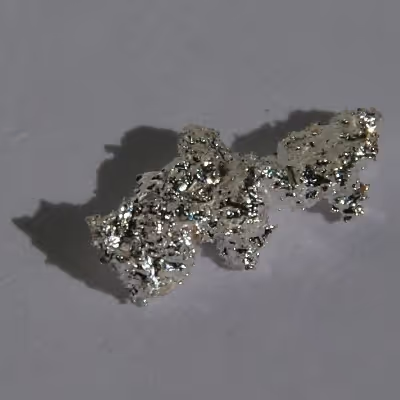
Silver is a chemical element with symbol Ag (Greek:άργυρος árguros, Latin:argentum, both from the Indo-European root *h₂erǵ- for "grey" or "shining") and atomic number 47. A soft, white, lustrous transition metal, it possesses the highest electrical conductivity, thermal conductivity and reflectivity of any metal. The metal occurs naturally in its pure, free form (native silver), as an alloy with gold and other metals, and in minerals such as argentite and chlorargyrite.
Periodic table
| Shell | Electrons | Orbitals |
|---|---|---|
| 1 | 2 | 2 in 1s |
| 2 | 8 | 2 in 2s + 6 in 2p |
| 3 | 18 | 2 in 3s + 6 in 3p + 10 in 3d |
| 4 | 18 | 2 in 4s + 6 in 4p + 10 in 4d |
| 5 | 1 | 1 in 5s |
Electron shells
lustrous white metal Appearance
108 u Atomic Mass
1.6 Å Atomic Radius
2.44k K Boiling Point
11 Group
1 Common Oxidation States
1.45 Å Covalent Radius
10.5 g/cm³ Density
126 kJ/mol Electron Affinity
1s2 2s2 2p6 3s2 3p6 4s2 3d10 4p6 5s1 4d10 Electron Configuration
[Kr] 4d10 5s1 Electron Configuration (semantic)
1.93 Electronegativity
47 Electrons
7.58 eV First Ionization Energy
1, 2, 3 ICSD Oxidation States
731, 2070, 3361 kJ/mol Ionization Energies
1.23k K Melting Point
71 Mendeleev Number
25.4 J/(mol·K) Molar Heat
5 Number of Shells
61 Neutrons
47 Atomic Number
27 Number of Isotopes
1, 2, 3 Oxidation States
5 Period
Solid Phase
47 Protons
2, 8, 18, 18, 1 Electron Shell Occupations