1 - Hydrogen diatomic nonmetal
Discovered by Henry Cavendish in 1766
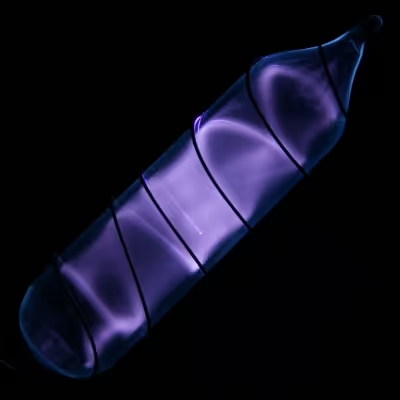
Hydrogen is a chemical element with chemical symbol H and atomic number 1. With an atomic weight of 1.00794 u, hydrogen is the lightest element on the periodic table. Its monatomic form (H) is the most abundant chemical substance in the Universe, constituting roughly 75% of all baryonic mass.
Periodic table
| Shell | Electrons | Orbitals |
|---|---|---|
| 1 | 1 | 1 in 1s |
Electron shells
colorless gas Appearance
1.01 u Atomic Mass
0.25 Å Atomic Radius
20.3 K Boiling Point
1 Group
-1, 1 Common Oxidation States
0.31 Å Covalent Radius
0.0000899 g/cm³ Density
72.8 kJ/mol Electron Affinity
1s1 Electron Configuration
1s1 Electron Configuration (semantic)
2.2 Electronegativity
1 Electrons
13.6 eV First Ionization Energy
-1, 1 ICSD Oxidation States
1312 kJ/mol Ionization Energies
14.2 K Melting Point
103 Mendeleev Number
28.8 J/(mol·K) Molar Heat
1 Number of Shells
1 Electron Valency
0 Neutrons
1 Atomic Number
3 Number of Isotopes
-1, 1 Oxidation States
1 Period
Gas Phase
1 Protons
1 Electron Shell Occupations
14.3 J/(g K) Specific Heat